
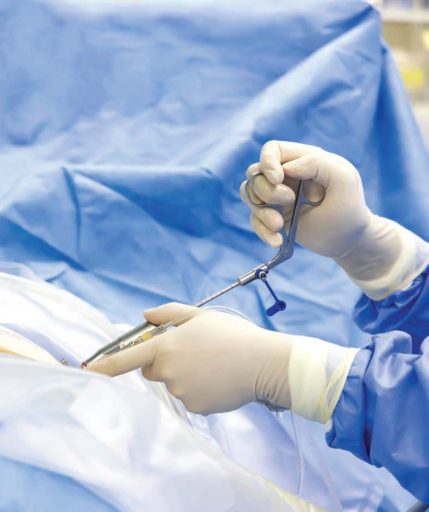
The prospect of spinal surgery has long sent shockwaves of fear and trepidation through patients and referring practitioners. Invasive surgery, long recovery times and the concern about needing repeated procedures in the future come to mind.
Key messages
- Endoscopic key-hole spine surgery is increasingly being employed to treat problems previously only open surgery could address
- Modern spinal endoscopes utilise new technology, this is not universally adopted or available everywhere, yet
- Patients need careful expectation management, not all pathology can be addressed with key-hole techniques.
Safely visualising delicate neural structures often meant extensive surgery. In recent years, advancements in optical and camera technology have miniaturised the equipment commonly used for procedures such as arthroscopy and laparoscopy allowing them to be usefully employed in spine surgery.
Key-hole spinal surgery, known as spinal endoscopy, has long been trailed but with varying success internationally. It has been spurred on though by the successful adoption of endoscopic and arthroscopic procedures in other surgical disciplines. Who remembers the last patient who underwent an open cholecystectomy or ACL reconstruction? All are now done with key-hole laparoscopic or arthroscopic techniques.
Access to the spine is challenging with limited safe working corridors previously limiting the useful introduction of key-hole equipment that was often quite large. Device technology has reached the point where this can be achieved safely.
While most disc prolapses causing sciatica self-resolve over six weeks, those with persistent neuropathic pain or ‘sciatica’ are difficult to manage, often progressing to needing analgesia that impairs daily function. The prospect of open surgery that comes with an 8 to 12-week recovery period before returning to normal work duties is also undesirable especially in the typical young working demographic. The desire to improve the current standard of surgical treatment often offered to these patients is clear.
Endoscopic spinal surgery
At the forefront of innovation stands endoscopic spinal surgery. This approach represents a monumental shift in the field of sciatica treatment, offering a streamlined path to recovery while minimising the invasive nature of traditional open surgeries.
Essentially, key-hole surgery involves making a tiny (typically 8mm) incision, through which specialised instruments and a miniature camera are inserted. The camera provides real-time visualisation of the surgical site and, given the high-quality optics achieved, it is superior to a typical image from an operating room microscope (once considered the gold standard).
By accessing the affected area through such a small opening, the disruption to surrounding muscles and tissues is dramatically reduced, resulting in diminished post-operative pain, scarring, and an expedited return to normal activities.
Advantages
- Recovery: Perhaps the most remarkable advantage of endoscopic spinal surgery is its ability to significantly accelerate the recovery timeline. With minimal tissue damage and reduced trauma, patients return to their normal activities sooner, compared to conventional open surgeries.
- Minimal scarring: Whilst the cosmetic scaring is inherently reduced, this often isn’t a concern on the back. Minimising the scar tissue generated within the muscles and around deeper neural structures is vital in returning to maximal function quickly.
- Post-operative pain: Postoperative pain is a substantial concern for patients undergoing surgery. With keyhole spinal surgery, patients experience less pain and less dependence on opioid analgesia after their surgery, most don’t require this at all.
- Shorter hospital stays: Patients undergoing endoscopic discectomy for sciatica will typically be cleared by physiotherapy the day of their surgery and spend less than 24 hours in hospital.
- Patient outcomes: Patient reported outcomes scores relating to pain relief and return to function have been extensively researched and reported to show that effective treatment can be achieved utilising these endoscopic techniques.
Disadvantages
Like all advances in medical technology, they come at a cost. The equipment is specialised and costly, and it is not available at every hospital in WA. Further, the procedure requires specialised training and accreditation to be able to perform. The burden of this training and development of experience in the technique ultimately falls on the hospitals and surgeons with a significant cost. As such it has not been widely adopted among all practitioners.
In navigating the decision, our guidance plays a pivotal role in steering patients toward the most suitable treatments. Endoscopic key-hole spinal surgery will likely allow more patients to undergo effective treatment of their sciatica pain and with a recovery that is more acceptable to them.
Like most medical treatments, managing expectation is key. This treatment may not be appropriate for all. As innovation and advancement continues, the aim will be to further adopt keyhole techniques to reduce the invasiveness of all surgery, improve outcomes and drive safety.
– A/Prof Greg Cunningham (25 October 2023)